
In the traditional world of software development, building an application was often a “wait and see” game. You would pitch an idea, wait months for a prototype, and hope the market hadn’t moved on by the time you launched.
Today, that bottleneck is disappearing. The rise of Low-Code/No-Code (LCNC) platforms is shifting the power of creation from a small group of specialized engineers to anyone with a logical mind and a problem to solve.
Breaking Down the Buzzwords
While often grouped together, Low-Code and No-Code serve different masters. Here is a quick breakdown of how they compare to traditional development:
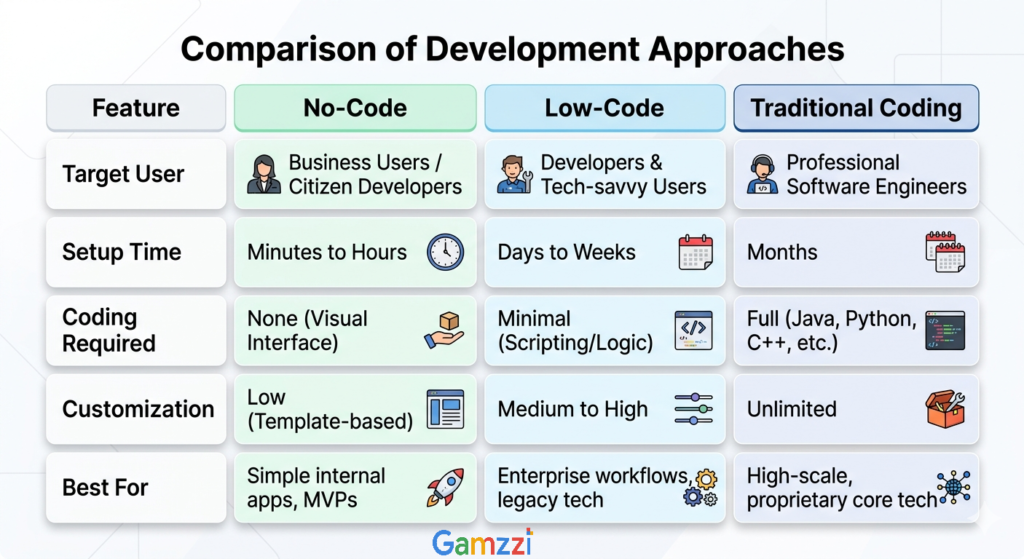
The Speed vs. Complexity Trade-off
[Image: A line chart showing ‘Development Speed’ starting very high for No-Code but dropping as complexity increases, contrasted with ‘Traditional Coding’ which starts low but maintains steady performance at high complexity.]
Why the Shift is Happening Now
The demand for digital solutions is currently outstripping the supply of professional developers. LCNC is a strategic necessity for three main reasons:
1. Velocity at Scale
Business moves at the speed of light. LCNC allows teams to move from “napkin sketch” to “functional MVP” in days rather than months. When you reduce the friction of syntax, you increase the frequency of experimentation.
2. Bridging the IT/Business Gap
Historically, there has been a “lost in translation” phase between what a business user needs and what a developer builds. By allowing business users to build their own tools, that gap vanishes. The person who understands the problem is now the person building the solution.
3. Empowering the Citizen Developer
Your operations manager, your HR lead, and your marketing specialist all have “micro-inefficiencies” they deal with daily. LCNC gives them the power to automate their own workflows without waiting for a spot on the IT department’s roadmap.
The Reality Check: Is it a Replacement for Developers?
Let’s clear the air: No, LCNC will not replace software engineers. In fact, it does something better: it liberates them. By offloading simple dashboards and internal tools to non-developers, professional engineers can focus on:
- Building scalable architecture.
- Ensuring robust security protocols.
- Developing complex, proprietary algorithms.
- Managing deep-tech integrations.
Potential Roadblocks to Watch
While the benefits are massive, organizations must be mindful of:
- Shadow IT: Employees building apps without IT oversight can lead to security gaps.
- Vendor Lock-in: It can be difficult to migrate data if you decide to leave a specific platform.
- Scalability Limits: A no-code app that works for 10 users might struggle when scaled to 10,000 without architectural adjustments.
The Bottom Line
The future of development is collaborative. We are moving toward a world where “developer” is no longer just a job title, but a skill set that exists across every department.
Whether you are a startup founder looking to save on initial burn or a corporate leader trying to modernize legacy processes, Low-Code/No-Code is your fastest path to “done.”
What’s your take? Has your team adopted LCNC tools yet, or are you still sticking to traditional builds? Let’s discuss in the comments.
See how we can accelerate your AI journey: 🔗 Gamzzi AI Development Services